STORY OF IDENTITY
A gnarled olive tree, growing in every direction – upwards, then downwards, to the left or right, forwards or backwards – describes my journey through life more aptly than any straightforward biography ever could.
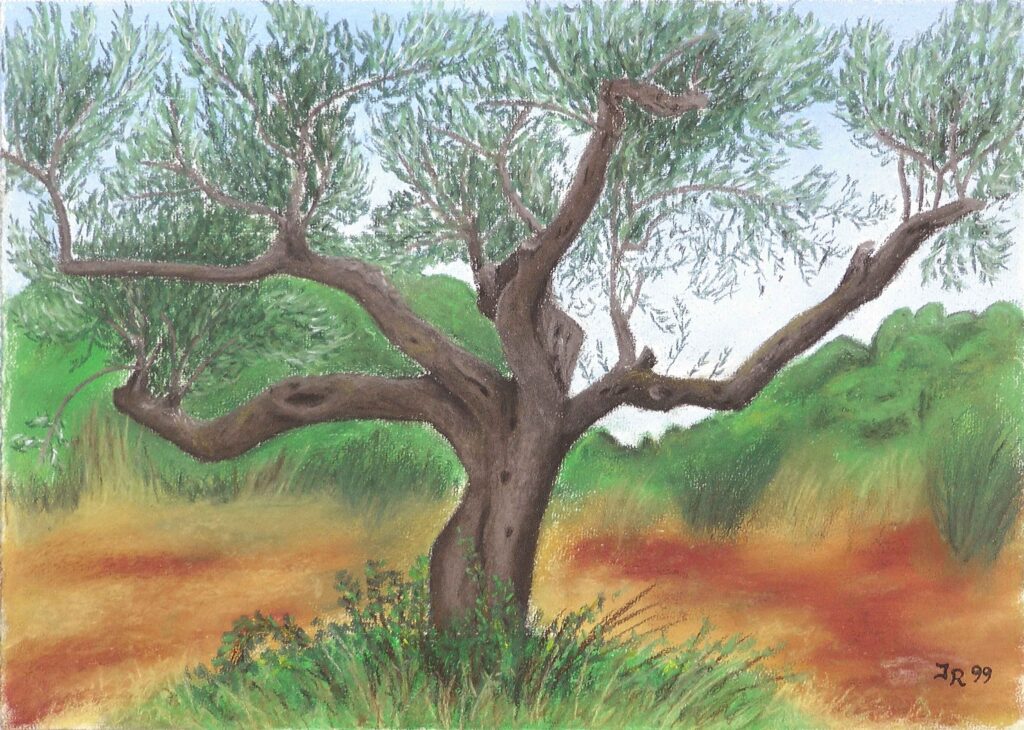
An olive tree grows slowly. It takes time to develop its own character. It withstands drought, weathers storms and bears the marks of everything it has endured. Sometimes a branch breaks. Yet somewhere, new growth emerges. Not as a return to what was, but as a new beginning.
Perhaps that is what my Story of Identity is about.
I was born in Freistadt, Austria, in 1969 and grew up in a remote village in a region that was considered poor at the time. There was little there – apart from a rich and diverse natural environment. From an early age, I began searching for my own path.
Grammar school was primarily seen as a means of securing a future. “Get your Matura, and one day you’ll earn good money” – this was the prevailing message. At the same time, school laid the foundations for my humanistic outlook and nurtured an increasingly critical way of looking at the world. I began to question what others simply accepted as given.
Yet challenging the status quo was not necessarily considered appropriate for a girl.
Adaptation, achievement, professional security and material prosperity were highly valued. At the same time, I discovered something as a child that did not fit into this way of thinking: my fascination with colour, drawing and painting.
Painting became my personal retreat – a place where I could pause, follow my thoughts and reflect on the world. I would voluntarily take art assignments home so that I could spend more time working on them. During the holidays, I devoted myself to reverse glass painting, a traditional part of the cultural heritage of the region.
As I painted, a realisation gradually began to take shape: I did not want simply to accept the world as it had been handed down to me.
Too often, I saw material values placed above human ones. Wealth brought recognition, social status and respect – even when it was accompanied by condescension or arrogance. Even when it came to relationships, financial security seemed to matter more than character.
I began to understand that my own values were different.
Passing my Matura finally opened the door to a world beyond this narrow environment. But even then, I had to compromise. Studying art was considered “a career with no prospects”. Architecture was viewed in much the same way – at least if your family did not already own an architectural practice.
So, in 1987, I chose to study process engineering and moved to Graz.
On paper, it seemed like a sensible path: a degree with good career prospects, leading to a profession in which engineers were in demand and well paid. Yet my first practical experiences showed me just how fiercely competitive and uncompromising this professional world could be.
The longer I remained in it, the more strongly I felt that I was losing a part of myself. Personal, intellectual, spiritual and moral values seemed to have to take second place to material, economic and profit-driven priorities.
Eventually, I realised that this was not who I was.
I did not want to follow a path that, in my eyes, would ultimately cost me meaningful relationships, a loving family, genuine friendships and a clear conscience.
So I left that path behind.
And perhaps it was not an ending, but a change of direction.
I married, devoted myself wholeheartedly to raising my two children and, alongside family life, found my way back to painting. I began with pastels. Later, I discovered acrylics. The urge to make space for painting in my life had never truly disappeared.
It had simply been waiting.
Without access to formal artistic training, my journey as an artist was initially shaped largely by self-directed learning. I experimented, observed, discarded and started again. Since 2008, I have regularly taken the opportunity to develop my skills through art courses and painting trips, learning through exchange with experienced artists.
Among others, I received important inspiration from Eftichia Schlamadinger, Berenike Wasserthal-Zuccari, Edgar Miesbichler, Helga Hudin, Therese Kniepeiß and Wolfgang Baxrainer – through acrylic painting, life and portrait drawing, rapid sketching, watercolour and experimental techniques.
But even here, my aim was never to adopt a prescribed style.
It was to find my own.
Today, my artistic focus is primarily on acrylic painting, complemented by occasional watercolour works. Both media offer me a rich spectrum of expressive possibilities and form the foundation of my visual language.
Out of this personal journey, my own style of painting eventually emerged:
Rentz_Art
Fluid lines run like a delicate network through layered colour compositions. They connect, overlap and intertwine. To me, they reflect the interconnectedness and constant interplay that shape every form of existence.
Nothing truly exists in isolation.
People, experiences, memories, thoughts and the environment in which we live influence one another. Some connections are visible; others remain hidden. Some lead directly to their destination, while others branch off, lose their way or suddenly begin anew.
Like the branches of an olive tree.
This is how I understand my own artistic journey.
My paintings are not depictions of a predetermined destination. They are traces of a journey – shaped by observation, questioning and reflection. Each work carries something of what has fascinated, moved, influenced or shaped me.
What interests me is not only what is visible.
I am interested in what lies between things. Connection. Change. The question of what happens when we leave a familiar perspective behind and become willing to look differently.
Perhaps that is why, for me, art is less an answer than an invitation.
An invitation to follow the lines, discover connections and, for a moment, walk a small part of my path with me.
My painting seeks to open spaces – spaces for inner and outer reflection, for new thoughts and for the possibility of seeing what we take for granted from a different perspective.
Because identity, to me, is not something finished.
It grows.
It changes direction.
It bears the traces of its history.
And it continually finds new ways to grow.