Watercolour on mould-made paper
sold
41 × 31 cm
At first glance:
a fountain and a stairway.
At second glance:
a dialogue between different eras.
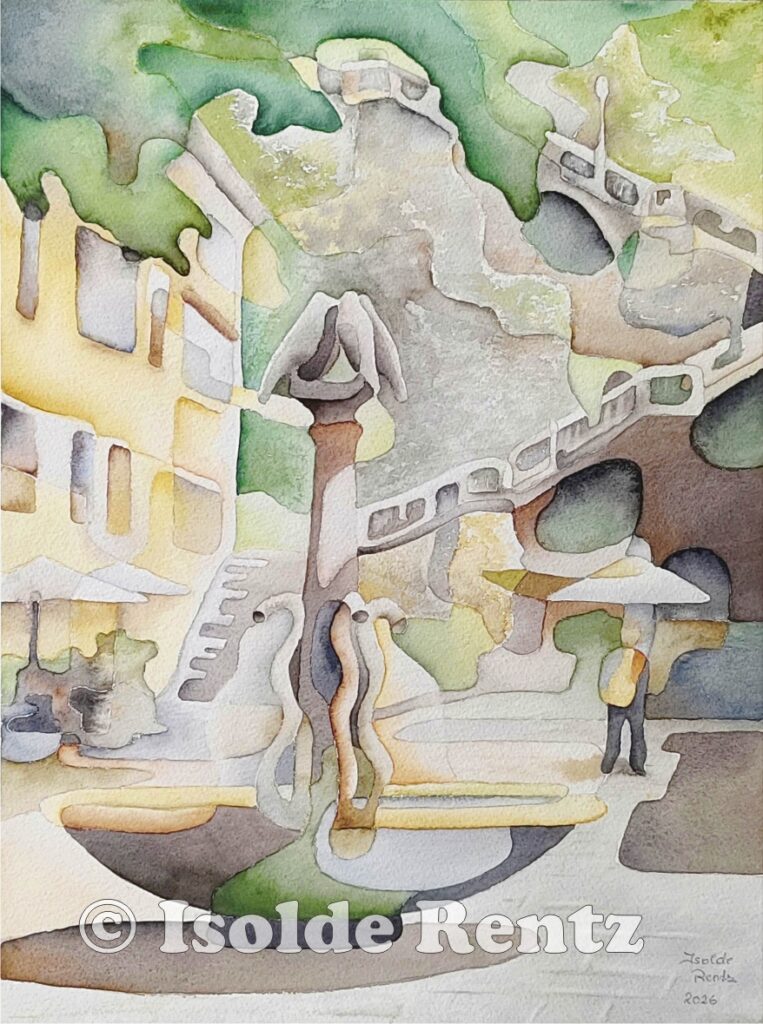
Schlossberg Square in Graz: an unassuming fountain crowned by four doves and the Schlossberg Stairway, also known as the “War Stairway” (Kriegssteig), enter into a historical dialogue. The stairway was carved into the rock during the First World War with the assistance of Russian prisoners of war. The Dove Fountain was erected decades later, after the Second World War.
Whether the four doves were intentionally conceived as a symbol of peace in relation to the War Stairway is not documented. Yet the interplay between these two sites creates a moving dialogue between remembrance and hope.
Between the Memory of War and the Sign of Peace
This watercolour seeks not merely to depict a square in Graz but above all to make visible the story that became inscribed there during the first half of the twentieth century. Two testimonies from different eras enter into dialogue:
In the foreground stands the Dove Fountain, designed by Walter Ritter and erected in 1949. Four doves crown the central column, while water flows from serpent-shaped spouts into the basin below. Its impact derives not from monumentality but from its quiet presence.
Behind it rises the historic “War Stairway”, carved into the rock between 1914 and 1918 by Austrian military engineers and Russian prisoners of war. Created under the conditions of the First World War, it still bears the traces of the era in which it came into being.
The painting makes this historical tension visible without addressing it explicitly. The stairway appears as a path up the mountain, but also as a reminder of labour, hardship and war. The fountain, by contrast, provides a calm counterpoint. Its doves traditionally symbolise peace, reconciliation and hope. Whether Walter Ritter consciously intended the fountain as a counterpart to the War Stairway is not documented. Yet the interaction of the two motifs gives rise to a compelling symbolic interpretation.
The solitary figure at the right-hand edge of the painting reinforces this impression. The figure moves through an urban space where different layers of time overlap: the war years of the early twentieth century, the period of reconstruction after 1945, and the present day.
In this way, the watercolour becomes more than a cityscape. It tells a story of memory and transformation, of the scars left by history and the quiet signs of peace that stand in contrast to them.