Money affects us all.
We all believe in money - without questioning, without doubting.
Money does something to us.
Mammon - the idolatrous worship of wealth, and mania - the compulsive addiction to it, elevate money to the new religion.
In analogy to the ten commandments from the Old Testament, ten pictures are being created in this project. Their titles are rewritten from their original theological-ethical formulation into a formulation focussed on money. What was originally intended to be understood as a guide to moral and ethical behaviour mutates into an image of consumption-oriented and possessive behaviour in the sense of a functioning financial system.
1st commandment: You shall believe in money
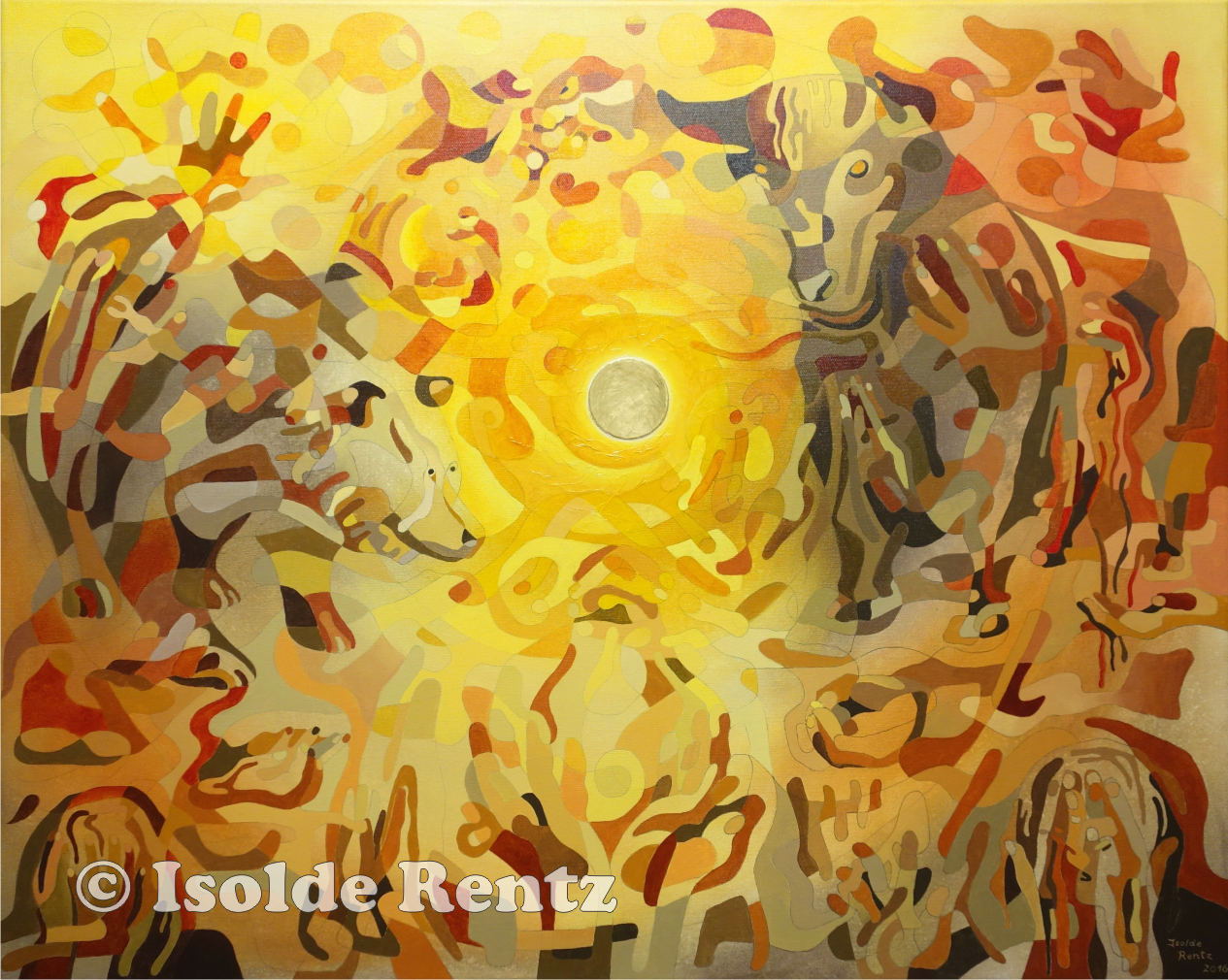
Acrylic / mixed media
80 × 100 cm
Finishing:
High-gloss gilding with 23.75 carat Rosenoble double gold
Belief in money must be absolute.
We all believe in money, which is basically just a promise – and all people are guided by this belief, regardless of their cultural, ideological or religious affiliation.
It is this unconditional belief that gives money great value, not only materially but also ideally, and places it at the centre of our actions and aspirations.
So we follow this subtle world of finance in the belief that money fulfils all our hopes - a life of health, happiness and peace.
But can you buy health, happiness and peace?
2nd Commandment: You shall not dishonour gainful employment.
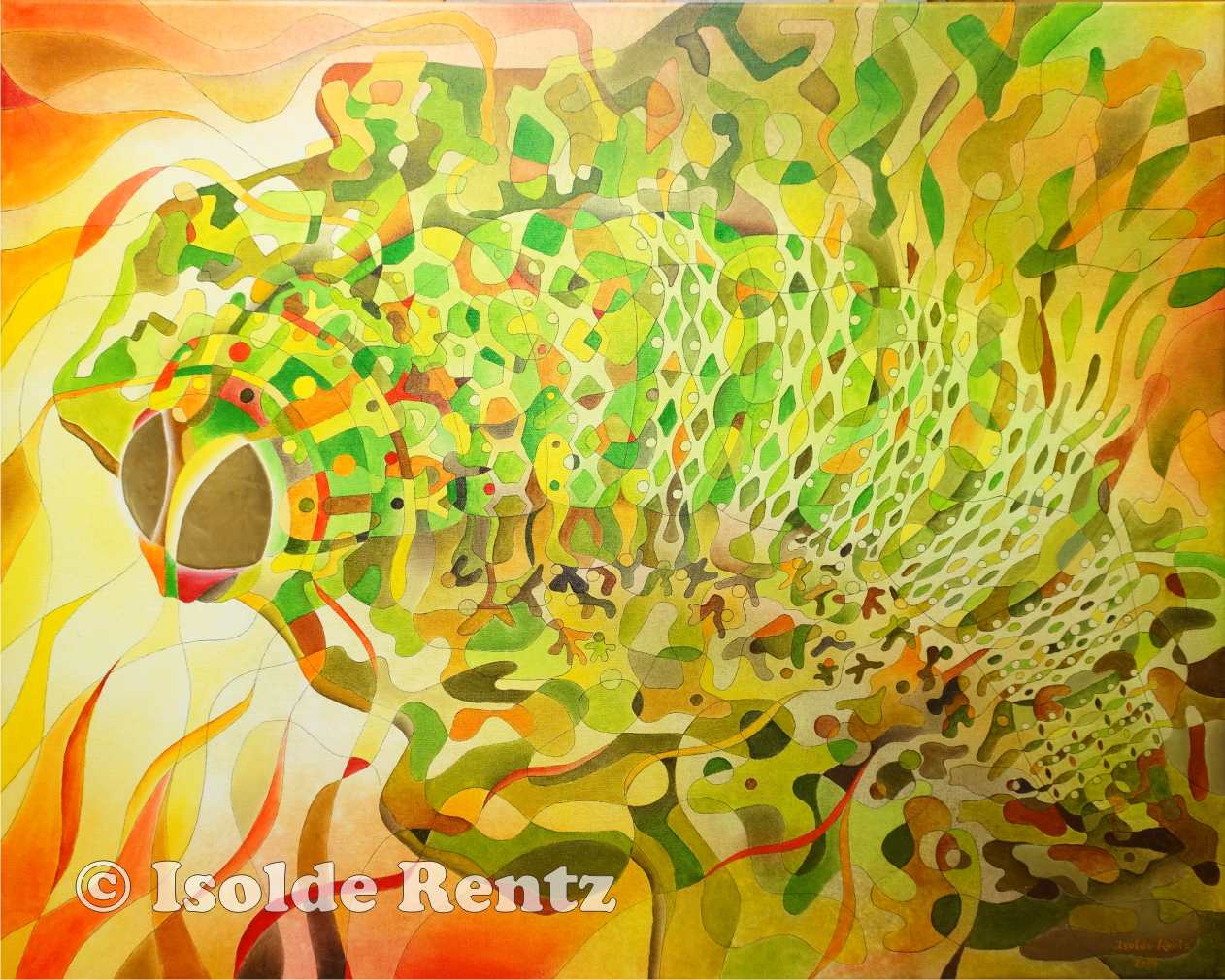
Acrylic / mixed media
80 × 100 cm
Finishing:
High-gloss gilding with 23.75 carat Rosenoble double gold
Money has to be earned.
Like silhouette figures, in our quest to earn as much money as possible, we force ourselves into the corset of the economy, which, like a caterpillar, wants only one thing: to grow.
Just as caterpillars can strip a whole tree bare, our desire for maximum profit consumes our planet's resources. The eyes of the caterpillar, which only see the money, are blinded to the abyss before them.
But there is no escape from this system. We are all part of it and cannot and must not break out of it. Those who do so fall out of the system and are just as lost.
3rd commandment: You shall sanctify the daily flow of money
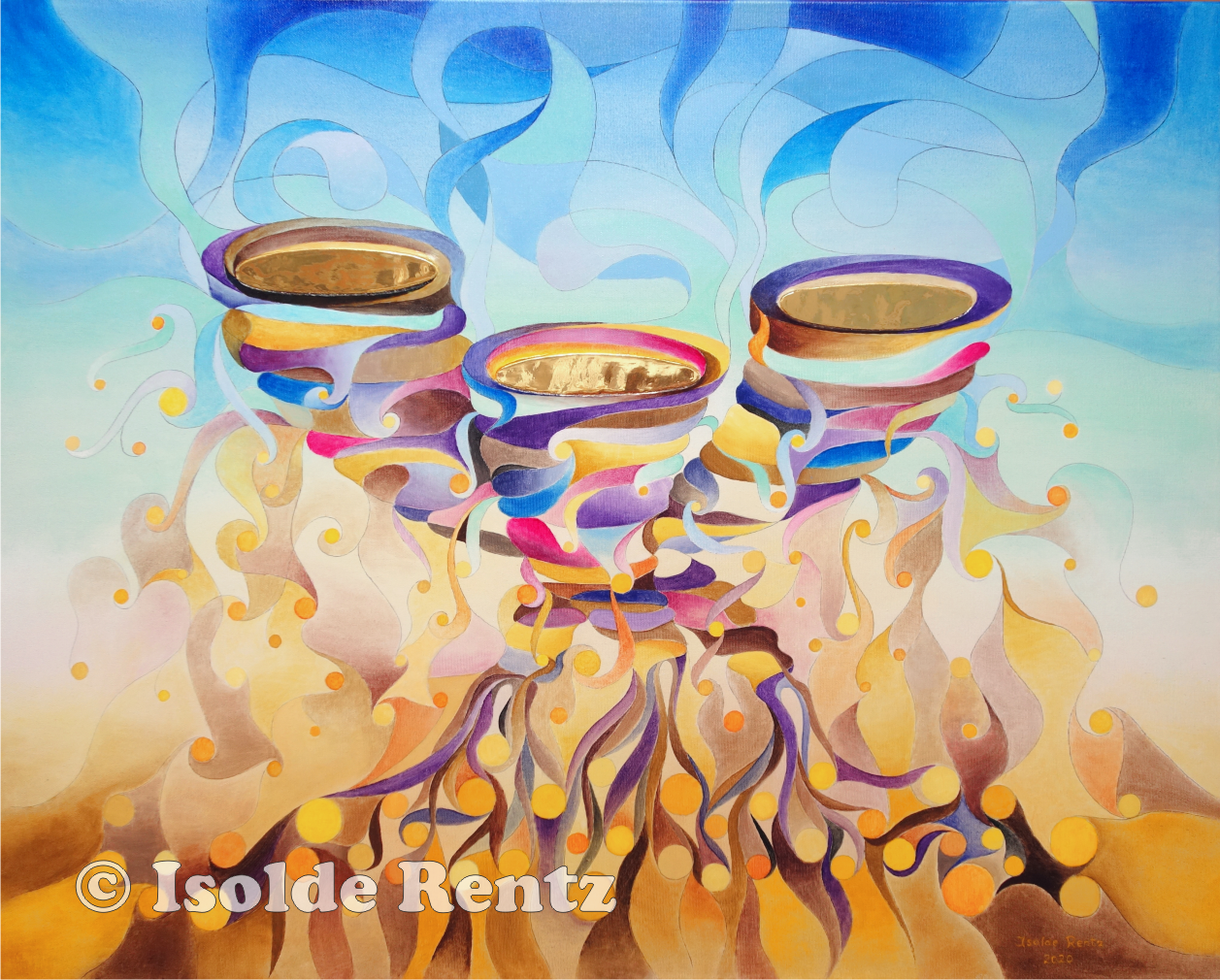
Acrylic / mixed media
80 × 100 cm
Finishing:
High-gloss gilding with 23.75 carat Rosenoble double gold
Money must flow so that the economy can flourish.
Through constant, sometimes even compulsive consumption, money should and must be kept in circulation. This consumption and destruction accepts exploitation.
The horns of plenty, symbolising superabundance and limitless multiplication, are growing skywards. Although the money is poured out again from above, more flows back upwards than can remain at the bottom. Their shape resembles a pair of scissors that have an almost insurmountable narrow point.
4th commandment: You shall honour external care.
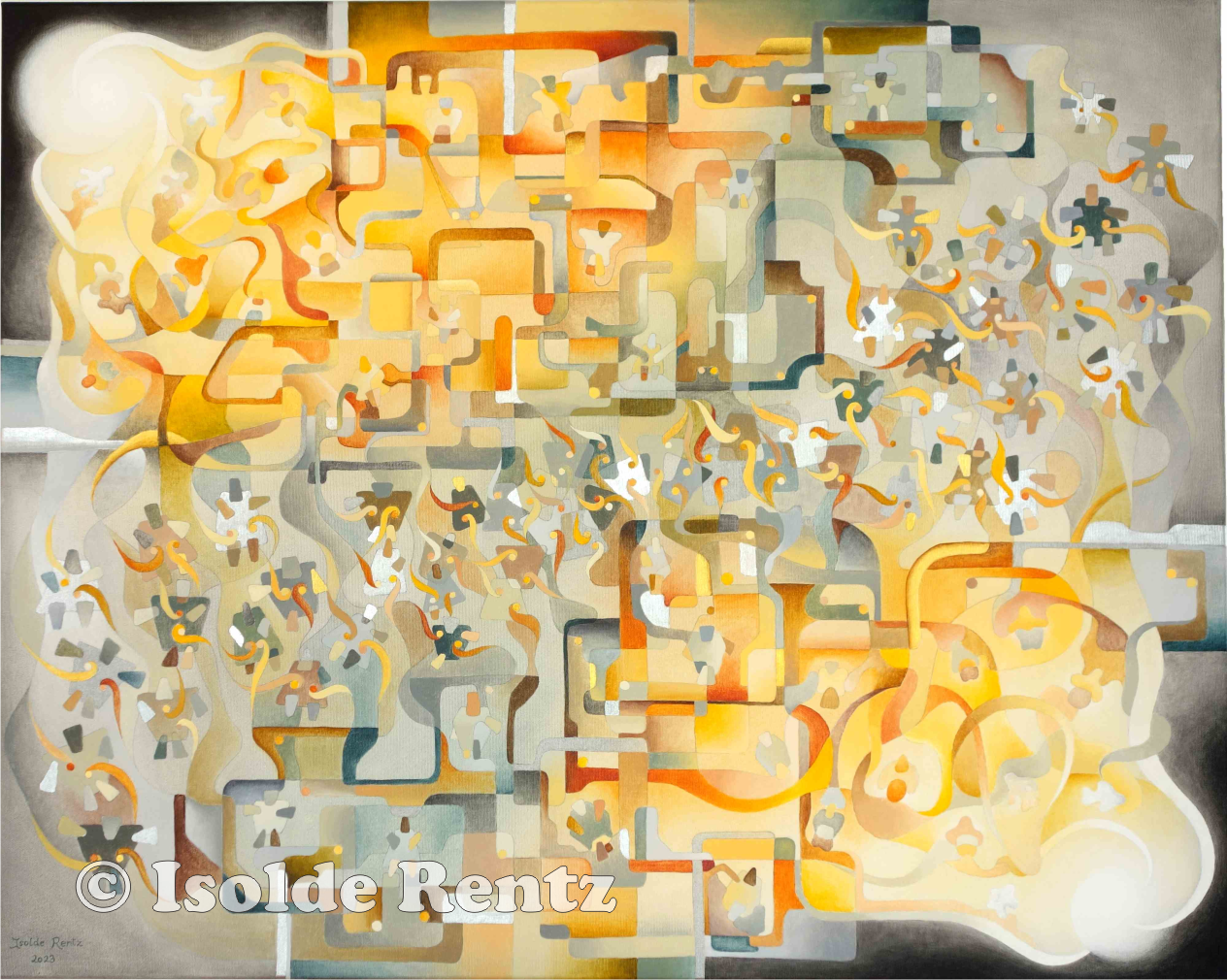
Acrylic on canvas
80 × 100 cm
Working people must pay a sufficient monetary contribution to the state for the external care of both the young in education and the old in retirement. The promise of this cash flow is:
Financial security and independence.
Financial security should be achieved through vocational training rather than through education for a successful free life.
The independence of the workforce from social tasks is necessary in order to optimise human capital in the increasingly demanding world of work. The time required for the personal care of family members should be replaced by external care so that the full utilisation of all potentially available workers and the deferral of family interests can be guaranteed.
This mutates the original basic idea of redistribution based on solidarity into a legal entitlement on an insurance basis with a fully comprehensive guarantee. This overlooks the fact that material security and independence alone are not enough for either young or old people.
5th commandment: You shall not waste time in vain.
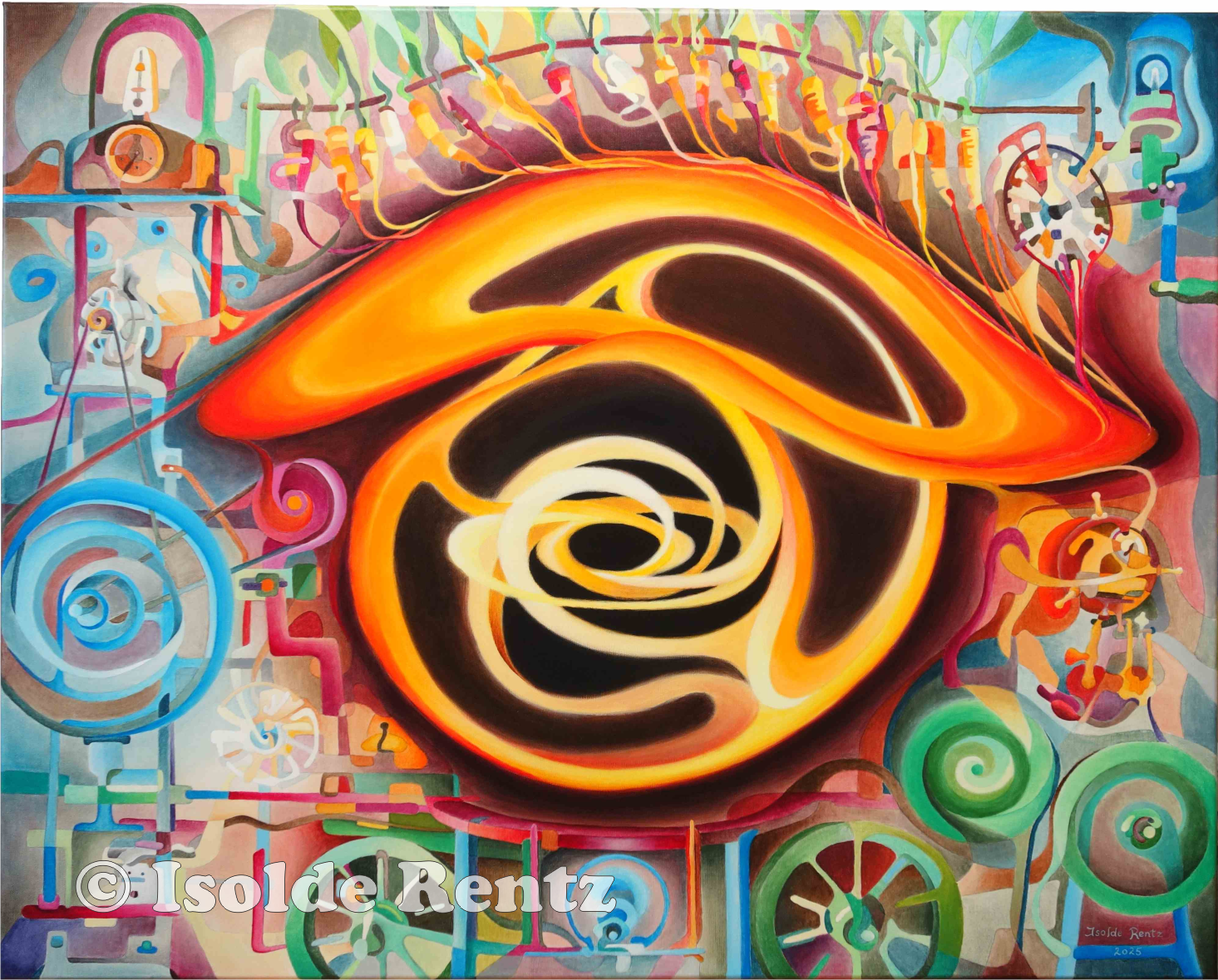
Acrylic on canvas
80 × 100 cm
Special colour black: Black 4.0
Time is ... earning and spending money.
Our economic system functions like a gigantic machine that not only enables the differentiation of our needs, but also drives it forward at an increasing speed. Markets are developing increasingly dynamically, forcing producers and consumers alike to utilise the given time budget efficiently.
In principle, modern people can freely dispose of their time, but the increase in productivity on the labour market and the cultivation of a certain style of consumption present them with an optimisation problem: on the one hand, there should be an abundance of options for satisfying needs; on the other hand, consumers want to base their purchasing decisions on the relatively greatest individual benefit of an item and they also want to consume as much of it as possible. This requires tight time management on both sides.
The interplay between the increasing generation and consumption of these desires finally exhausts itself in a racing carousel of time, which in its extreme form ends up in a black hole.
6th Commandment: You Shall Cultivate Your Relationship with Yourself
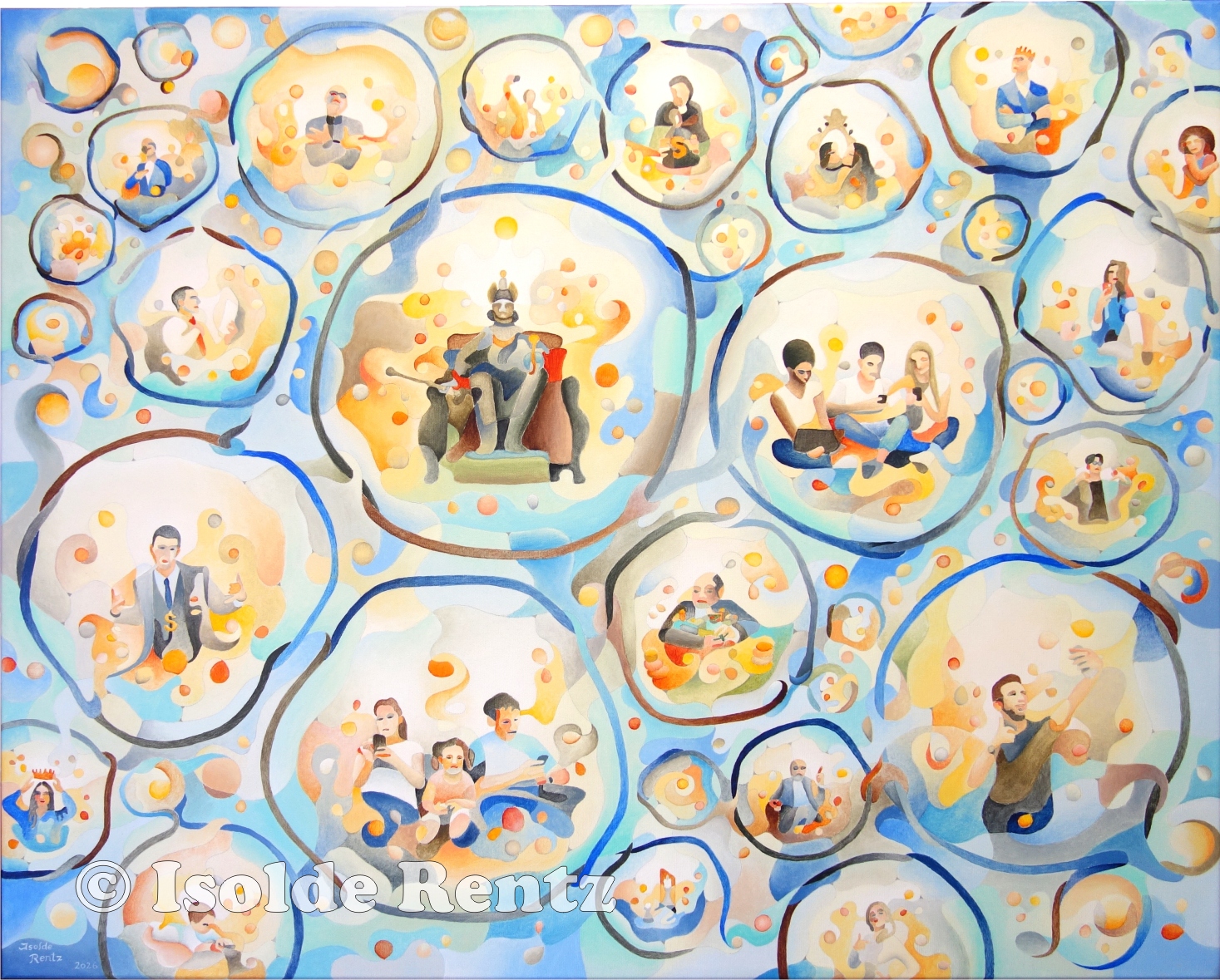
Acrylic on canvas
80 × 100 cm
The ideal of self-fulfilment is sustained by powerful promises: independence, wealth, prestige, influence and admiration. To attain these, one's relationship with the self is placed at the centre of life. As a result, people construct their own individual worlds within isolated bubbles that reinforce self-absorption while constantly inviting comparison with others.
At first glance, these bubbles appear light and weightless, floating effortlessly through space. Yet they are not places of refuge. They symbolise a society in which everything revolves around self-presentation, self-observation and self-affirmation. The multitude of small circles and particles surrounding and permeating the bubbles conveys the impression of a system that is constantly expanding. Although everything seems open and dynamic, the figures remain trapped within their own respective spheres.
Flowing lines run between the bubbles, stretching like a network across the entire canvas. They connect the individual scenes while simultaneously creating a sense of perpetual movement. They also represent the promises of Mammon: recognition, success, visibility and status. At the same time, they constantly show us what others possess or project, giving rise to ever new desires.
And so new bubbles emerge.
New longings.
New dependencies.
The question posed by this painting is simple:
Has self-fulfilment become the new form of self-enslavement?
How much of our lives still truly belongs to us—and how much belongs to the economic interests that monetise our attention, our desires and our relationships?